
ADVANCED PRACTICE REGISTERED NURSES IN CONNECTICUT |
|
By: James Orlando, Senior Legislative Attorney |
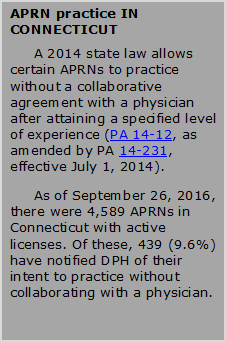
ISSUE Describe the law allowing certain advanced practice registered nurses (APRNs) in Connecticut to practice without a collaborative agreement with a physician.
APRN PRACTICE
Connecticut law gives APRNs with certain experience the option to practice without collaborating with a physician. “Collaboration” means a mutually agreed upon relationship between an APRN and a physician whose education, training, or experience is related to the APRN's work. Among other things, the collaboration must address (1) a reasonable and appropriate level of consultation and referral, (2) patient coverage in the APRN's absence, and (3) methods to review patient outcomes and disclose the relationship to the patient.
APRNs may practice without such collaboration if they have been licensed and practicing in collaboration with a physician for at least three years with at least 2,000 hours of such collaborative practice. APRNs who do not meet this experience requirement must practice in collaboration with a physician.
Before practicing without such collaboration, an APRN must notify the Department of Public Health (DPH) in writing of his or her intention to do so. Such an APRN must (1) maintain documentation of his or her completion of the above
collaborative practice requirement for at least three years after completing the requirement and (2) submit the documentation to DPH within 45 days of the department's request (CGS § 20-87a(b)).
Concerning an APRN's prescriptive authority, APRNs practicing without a collaborative agreement may prescribe schedule II, III, IV, or V controlled substances. For APRNs working in collaboration with a physician, the collaborative agreement must specify which Schedule II and III controlled substances the APRN may prescribe (they may also prescribe schedule IV or V controlled substances) (CGS §§ 20-87a(b)(2) & 20-94b). The law also specifies that a licensed APRN maintaining current certification from the American Association of Nurse Anesthetists who is prescribing and administering medical therapeutics during surgery may do so only if the physician who is medically directing the prescriptive activity is physically present in the setting where the surgery is taking place (CGS § 20-87a(b)).
There are a few other statutes that distinguish between APRNs practicing in collaboration with a physician and those practicing without such collaboration. By law, DPH must collect certain information to create individual public profiles for certain health care providers, including APRNs. The profile information for an APRN must include whether he or she is practicing independently or in collaboration with a physician under a collaborative agreement (CGS § 20-13j).
Starting by July 1, 2017, the law requires manufacturers of covered drugs, devices, biologicals, and medical supplies to annually report information on payments or other transfers of value they make to APRNs who are not practicing in collaboration with a physician (CGS § 21a-70f). These manufacturers will be required to report the same information required by federal law (the Physician Payments Sunshine Act) for payments or transfers of value to physicians, such as the (1) recipient's name and business address and (2) amount, date, and nature of the payment or transfer.
JO:bs