
ARTICLE V CONVENTIONS |
|
By: Terrance Adams, Associate Analyst |
QUESTION By what methods do states (including Connecticut) call for an Article V convention? Are there any issues for which an Article V convention is close to being triggered?
SUMMARY
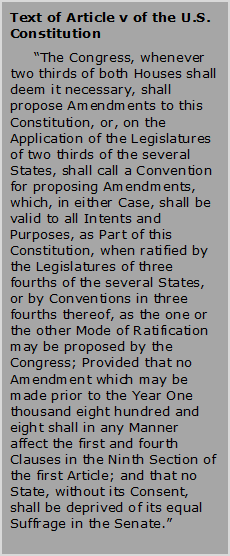
Article V of the U.S. Constitution establishes two amendment procedures. The first is for both houses of Congress to pass a proposed amendment by a two-thirds vote. The second is for Congress to call a constitutional convention (i.e., an Article V convention) upon the application of legislatures in two-thirds of the states (a total of 34), during which amendments may be proposed and approved. In both cases, an approved amendment must subsequently be ratified by three-quarters of the states (a total of 38). State ratification is by either the legislature or a state convention; Congress determines the ratification method.
States typically call for an Article V convention through a joint or concurrent resolution passed by both chambers. In Connecticut, the legislature's joint rules do not specifically address Article V conventions, but the state's previous Article V applications were by joint resolutions.
With the exception of a federal balanced budget requirement, it appears that there are not any current issues that are close to triggering an Article V convention. Advocates for holding such a convention argue that the balanced budget requirement has met the threshold for triggering a convention, but to date, Congress has not taken any steps toward convening one. During the 20th Century, other issues that came close to triggering an Article V convention included (1) direct election of U.S. senators and (2) state legislative apportionment.
Several questions exist about how an Article V convention would be triggered and operate, partly because (1) the U.S. has never held an Article V convention and (2) the Constitution does not specify a process for holding one. These questions include whether (1) state applications for an Article V convention are valid indefinitely or only for a specified period, (2) a state can rescind its application, (3) the call of the convention would cover the entire Constitution or be limited to a specific issue, and (4) a convention called for a limited purpose could consider issues outside its mandate (i.e., become a “runaway” convention).
STATE CALLS FOR AN ARTICLE V CONVENTION
Article V does not specify how state legislatures must call for a convention. According to the Congressional Research Service (CRS), most do so through a joint or concurrent resolution passed by both chambers. CRS notes that, in some states, an Article V application must meet the same standards as an amendment to the state's constitution (e.g., pass by a supermajority in both chambers). States often submit applications for a specific purpose (e.g., a federal balanced budget requirement), but some have also applied for a general Article V convention.
According to CRS, the consensus among legal scholars is that state applications for an Article V convention do not require gubernatorial approval. CRS cites a 1993 report by the House Judiciary Committee on Civil and Constitutional Rights, which concluded that Article V is clear that state legislatures alone apply for a convention. However, the committee's report found that some legislatures refer their Article V applications to the state's governor for approval. For instance, the committee analyzed the 32 applications that had been filed at that time for a balanced budget convention and found that 9 had been referred to the state's governor.
Connecticut Applications
CRS reports that neither Congress nor the National Archives maintain a centralized listing of Article V applications submitted by state legislatures. According to Friends of the Article V Convention (FOAVC), an organization that tracks state Article V applications and supports holding a convention, Connecticut has submitted two Article V applications to Congress. The General Assembly passed joint resolutions in 1949 and 1958 that called for Article V conventions to propose amendments (1) authorizing the U.S. to negotiate with other countries to draft a constitution for a world federal government (SJ 15, 1949) and (2) prohibiting states from taxing the income of nonstate residents (SJ 9, 1958).
The legislature's current joint rules do not contain any provisions addressing applications for an Article V convention, and we did not find any information about whether the two earlier resolutions were subjected to any special adoption requirements. The 1949 resolution appeared in the June 1, 1949 Congressional Record as being signed by the governor, but according to the Office of the Secretary of the State, the governor did not sign the actual resolution. Rather, it appears that the governor's facsimile signature was added to distribution copies of the resolution. The 1958 resolution appeared in the May 6, 1958 Congressional Record without the governor's signature.
PROGRESS TOWARD TRIGGERING AN ARTICLE V CONVENTION
Federal Balanced Budget Requirement
According to CRS, 34 states have filed Article V convention applications for a federal balanced budget requirement, the most recent of which was Michigan in March 2014. This total meets the two-thirds threshold necessary for triggering a convention, but to date, Congress has not taken any steps toward convening one. This appears to be due, in part, to a disagreement as to whether the threshold has actually been reached.
CRS notes that there are two main arguments supporting the view that the two-thirds threshold has not been reached. The first is that 12 of the 34 state legislatures passed joint resolutions rescinding their Article V applications. (Five other states rescinded their applications, but later filed new ones.) Convention supporters counter that Article V applications should be held to the same standard as constitutional amendment ratifications, which cannot be rescinded.
The second argument for not reaching the threshold is that the 34 applications are not contemporaneous with each other. Thirty two of the states filed their applications between 1975 and 1983, while the final two states (Ohio and Michigan) filed their applications in 2013 and 2014, respectively. CRS cites the House Judiciary Committee's 1993 report, which states that constitutional scholars generally agree that that Article V applications must be contemporaneous and should not remain valid indefinitely. The committee notes that many of these scholars favor a validity period of seven years, which matches the time period that Congress typically allows states to ratify a constitutional amendment. In response, CRS notes that convention supporters (e.g., FOAVC) argue that, because Article V is silent about the duration of an application's validity, applications remain valid indefinitely.
We did not find any court case that addresses the rescission or expiration of an Article V application. According to CRS, Congress has previously considered legislation to establish requirements and procedures for state applications and holding a convention, but none became law. Several of these bills would have established a seven-year validity period for state applications.
Other Issues
With the exception of a federal balanced budget requirement, it appears that there are not any current issues that are close to triggering an Article V convention. During the 20th Century, other issues that came close to triggering an Article V convention included (1) direct election of U.S. senators and (2) state legislative apportionment.
The direct election of U.S. senators became part of the Constitution when Congress passed, and the states ratified, the 17th Amendment. According to CRS, Congress acted after several states submitted applications to hold an Article V convention for this purpose. CRS notes that the effort to hold an Article V convention for state legislative apportionment began after the U.S. Supreme Court held that state legislative districts must have roughly equal populations (i.e., the “one person, one vote” principle) (Reynolds v. Sims, 377 U.S. 533 (1964)). In response, 33 state legislatures submitted Article V applications to overturn the decision (e.g., by allowing one house of a legislature to be apportioned based on factors other than population), one shy of the threshold needed to trigger a convention.
ADDITIONAL RESOURCES
Congressional Research Service: The Article V Convention to Propose Constitutional Amendments: Contemporary Issues for Congress http://www.fas.org/sgp/crs/misc/R42589.pdf
Congressional Research Service: The Article V Convention for Proposing Constitutional Amendments: Historical Perspectives for Congress http://www.fas.org/sgp/crs/misc/R42592.pdf
TA:ts